Formación continua/ Ciencias de la Salud/ B216

Workshop DNA–Protein Crosslinks: Mechanisms and Links to Rare Genetic Disorders

Organizers:

  • Iván V Rosado. Centro Andaluz de Biología y Medicina Regenerativa (CABIMER). Spain.
  • Fernando Gómez-Herreros. Instituto de Biomedicina de Sevilla (IBiS). Sevilla. Spain.
  • pendiente inicio
  • Desde: 18 Noviembre 2026
  • Hasta: 20 Noviembre 2026
  • Presencial
  • Investigadora
  • english
  • 20 horas lectivas
  • General Registration: 400 € / Reduced Tuition Fee: 250 €

Presentación y objetivos

The interaction of proteins with DNA during replication, transcription, and repair is precisely required to faithful transmission of genetic information. While transient protein–DNA interactions are essential for normal chromatin function, the aberrant stabilization of these protein–DNA contacts can culminate in the formation of covalent DNA-protein crosslinks (DPCs). These bulky, helix-distorting adducts arise through diverse chemical mechanisms — from the attack of reactive aldehydes and oxidative species to the abortive catalysis of topoisomerases and other DNA-processing enzymes — thus threatening genomic integrity at every stage of the cell cycle. Understanding how cells detect, tolerate, and ultimately resolve DPCs has emerged as one of the most exciting frontiers in genome maintenance research. Recent years have witnessed the discovery of dedicated DPC proteases, the unveiling of replication-coupled repair mechanisms, and the identification of specialized damage tolerance pathways at stalled forks. The pathological consequences of defective DPC repair have just started to emerge and are underscored by human syndromes characterized by premature aging and cancer predisposition linked to mutations in DPC repair factors.

This workshop brings together top-class researchers who have pioneered several aspects of DPC biology, working across DNA replication, repair, chromatin biology, structural biology, and cancer genomics to share cutting-edge discoveries and forge new collaborations. Whether your focus lies on mechanistic biochemistry, animal models of genomic instability, or the clinical implications of DPC accumulation in aging and cancer, this meeting offers a unique and timely forum to advance our collective understanding of this critical — and still incompletely understood — class of DNA damage.
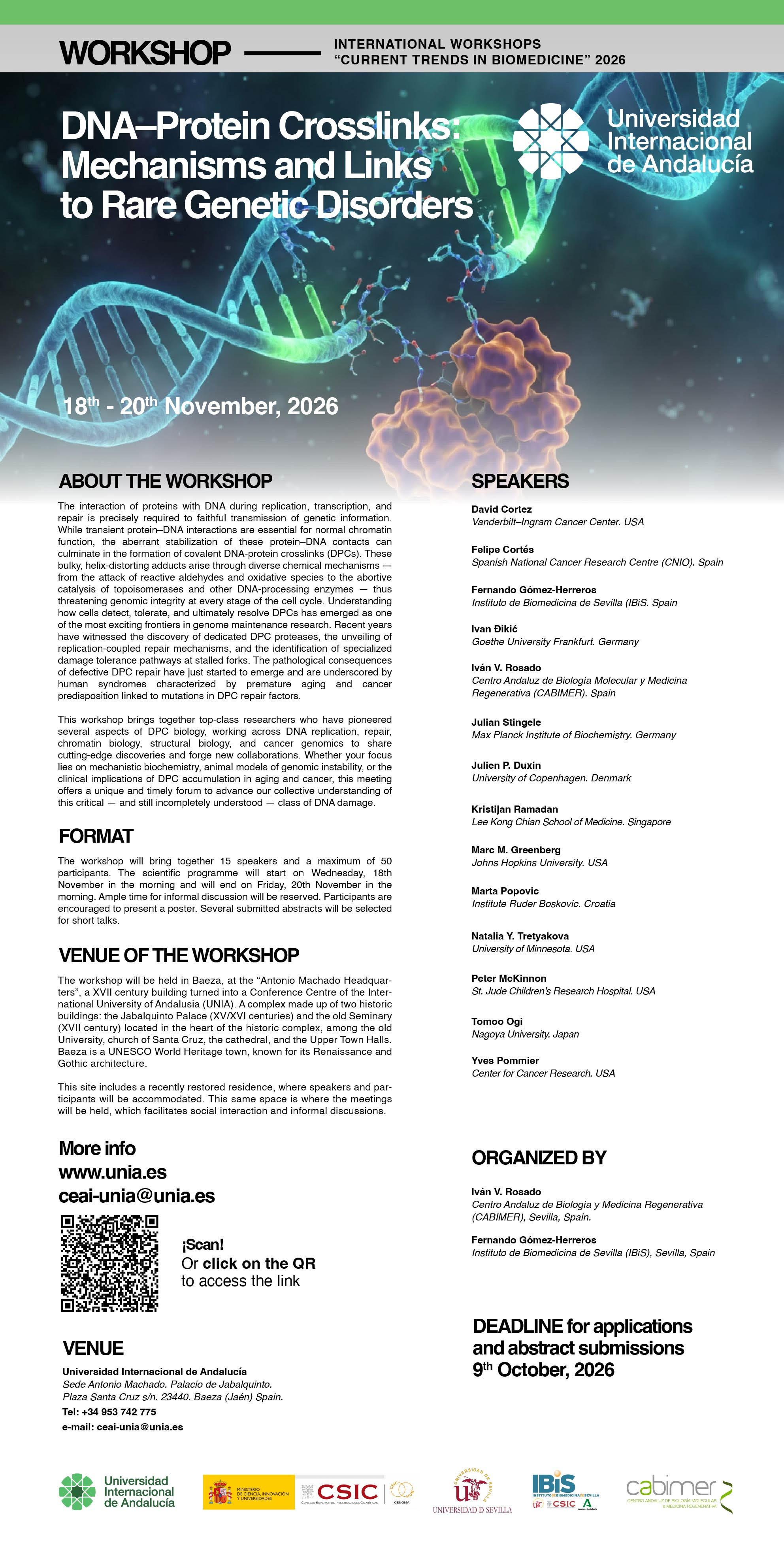
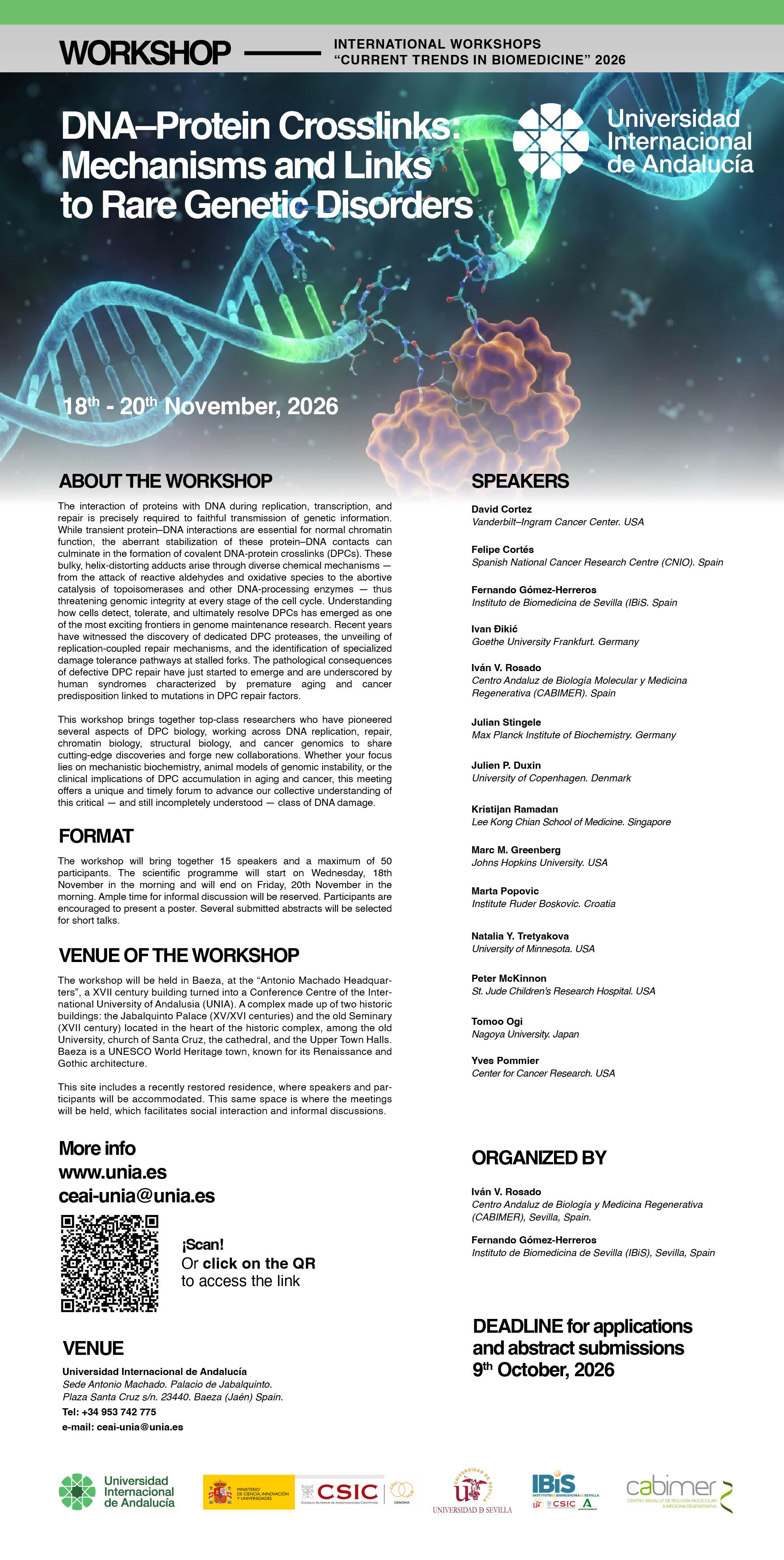
Poster_DNAprotein.jpg

Poster DNAprotein


Organizers:

  • Iván V Rosado. Centro Andaluz de Biología y Medicina Regenerativa (CABIMER). Spain.
  • Fernando Gómez-Herreros. Instituto de Biomedicina de Sevilla (IBiS). Sevilla. Spain.

Felipe Cortés, Spanish National Cancer Research Centre. Spain.

David Cortez, Vanderbilt–Ingram Cancer Center. USA.

Ivan Đikić, Goethe University Frankfurt. Germany.

Julien P. Duxin, University of Copenhagen. Denmark.

Marc M. Greenberg, Johns Hopkins University. USA. 

Peter McKinnon, St. Jude Children's Research Hospital. USA.

Tomoo Ogi, Nagoya University. Japan.

Yves Pommier, Center for Cancer Research. USA. 

Marta Popovic, Institute Ruder Boskovic. Croatia.

Kristijan Ramadan, Lee Kong Chian School of Medicine. Singapore.

Julian Stingele, Max Planck Institute of Biochemistry. Germany.

Natalia Y. Tretyakova, University of Minnesota. USA. 


Format of the workshop

The workshop will bring together 15 specialists representing different areas. Renowned academic experts, developing innovative managing solutions will share their findings and experiences.

Conferences will take place during all the day, followed by general discussions and guided debates based on different case studies. The daily workshops will be closured in a general assembly highlighting main conclusions and recommendations.

Afternoons networking space will enable young and senior researchers to liaise, exchange ideas and discuss potential collaboration opportunities through dynamic activities and informal meetings such as mentoring sessions, thematic working groups and participative debates.

Up to 35 additional participants are encouraged to present Posters with brief explanations during intermediate sessions.

Venue of the workshop

The workshop will be held in Baeza, at the “Antonio Machado Headquarters”, a XVII century building turned into a Conference Centre of the International University of Andalusia (UNIA). A complex made up of two historic buildings: the Jabalquinto Palace (XV/XVI centuries) and the old Seminary (XVII century) located in the heart of the historic complex, among the old University, church of Santa Cruz, the cathedral and the Upper Town Halls.

This site includes a recently restored residence, where speakers and participants will be accommodated. This same space is where the meetings will be held, which facilitates social interaction and informal discussions.

Baeza is a world historic heritage town, renowned for its Renaissance and Gothic buildings.

WORKSHOP panels/posters guidelines

Presentation of the proposal: through the registration form in the workshop (see THE APPLICATION GUIDELINES):

  • The co-directors of the Workshop will indicate and assign the session in which to present the work.
  • The organization will certify the effective presentation of each panel/poster during the workshop.
  • Each author individually or collectively may present a maximum of 2 panels.
  • Researchers may display their panel in the campus facilities. To do this, they must bring their work printed in DIN A0 vertical format (84.1 x 118.9 cm) and arrange it in the provided fastening systems.

Panel/poster contents:

  • Title
  • Authorship
  • Keywords
  • Introduction/Summary of content
  • Methodology
  • Results: Description and contents (through text and graphics)
  • Conclusions
  • Sources and essential bibliography
  • Acknowledgements
Workshop registration

Applicants must complete an Application form* and submit it, along with:

A) Brief C.V. 
B) Summary of the current research work of the candidate. 
C) Copy of DNI or Passport.
D) In case of presenting a poster, a summary of the poster of no more than one page, with the title, authorship, research center/institution/university, address and a summary of the communication. (See section "presentation of panels and posters”, in “Formate of the workshop”).

To apply

* See link to: APPLICATION_FORM_WORKSHOPS.docx

Send the completed Application Form and the attached documents as separate text files and in a single message, to  International University of Andalusia via the UNIA ticket service: sacu.unia.es, selecting the help group: "Gestión académica", and then "CEAI".

Submission Steps:

Open a Nuevo Ticket.
Once on the site, you will need to register before proceeding.
Select the Appropriate Options: in the two drop-down menus, please choose:
Grupo de ayuda:  Gestión académica.
Tema de ayuda: CEAI.
Selected applicants (with or without poster) will be notified directly by mail. From that moment on, they must pay the corresponding registration fees*.

Workshop fees 2026:

- General Registration: 400,00 € (breakfast, lunch, coffe-breaks and dinner included). (Regular General Registration rate is 400 € for senior researchers)
- Reduced Tuition Fee: 250,00 € (breakfast, lunch, coffe-breaks and dinner included). A Reduced Registration rate of 250 € is available for young researchers under the following circumstances: a) Students currently enrolled in a bachelors, master or associate graduate (doctoral) programs. A document verifying the student's enrollment must be provided on official letterhead/stationery. b) Young researchers with less than 7 years of postdoctoral experience. Applicants must submit official documentation certifying the date of defense of their doctoral thesis.  

The supporting documentation for the reduction in the import of the registration fee will be assessed with reference to the closing date for applications, and the submission of new documentation will not be accepted once the closing date for applications has ended, 9th October 2026.

Payment method: bank transfer to ‘La Caixa’.

Details of the Beneficiary

Beneficiary: Universidad Internacional de Andalucía; CIF. Q-7350007-F.
Address: Plaza de Santa María, s/n., CP 23440, Baeza (Jaén), España.
Telephone number: +34 953 742 775.
Bank Account Details

Beneficiary Bank: La Caixa.
Address: C/ Sierpes, 85-Planta 2 - CP 41004 Sevilla - España.
Telephone number: +34 954 59 71 97.
Account number: 2100 9166 75 2200074348.
Foreign Currency: euros.
Electronic IBAN format: ES7821009166752200074348.
Paper-format IBAN: ES78 2100 9166 7522 00074348.
IBAN (international bank account number): ES78 21009166752200074348.
SWIFT (BIC): CAIXESBBXXX.

Selected applicants must indicate their full name and code B216 in the bank transfer. After completing your payment by bank transfer, a proof of payment must be sent to: Esta dirección de correo electrónico está siendo protegida contra los robots de spam. Necesita tener JavaScript habilitado para poder verlo..

The bank charges generated by the bank transfer will be paid by the applicants/attendees.

Registration fees deadline: 9th October 2026.

Accommodation

We recommend all participants to stay in the University Residence, which is located in the same space where the Meetings will take place, to facilitate social interaction and informal discussions.

The accommodation in the University Residence is in shared double rooms, € 20/day and single rooms € 40/day.

To make the reservation and the corresponding payment you must be previously registered for the workshop and then contact:

Esta dirección de correo electrónico está siendo protegida contra los robots de spam. Necesita tener JavaScript habilitado para poder verlo.

Subir

Matrícula y becas

Situación actual:

  • pendiente inicio

Conoce nuestro propio programa de becas y consulta en las bases de la convocatoria los casos donde la beca contempla exención de precios o una ayuda económica.

Subir