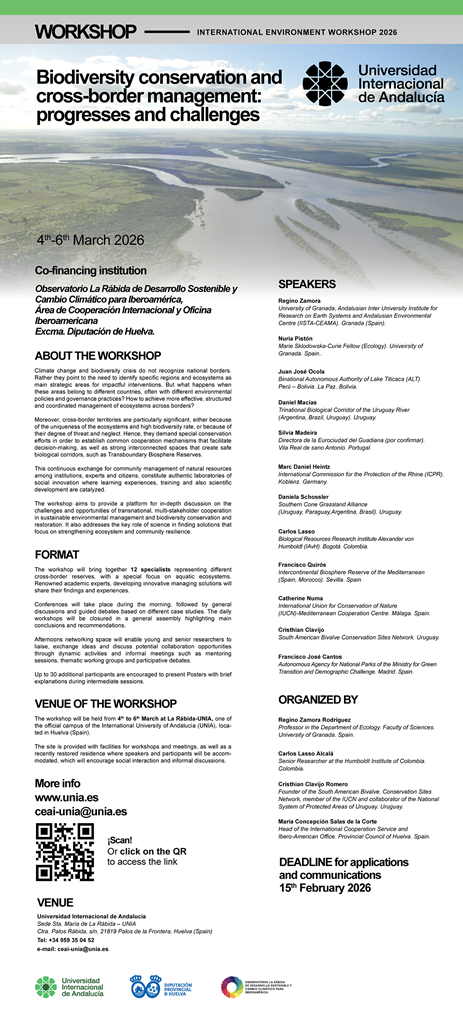
Workshop: Biodiversity Conservation And Cross-Border Management: Progresses And Challenges
Organizadores:
Regino Zamora Rodríguez. Professor in the Department of Ecology. Faculty of Sciences. University of Granada. Spain.
Carlos Lasso Alcalá. Senior Researcher at the Humboldt Institute of Colombia. Colombia.
Cristhian Clavijo Romero. Founder of the South American Bivalve. Conservation Sites Network, member of the IUCN and collaborator of the National System of Protected Areas of Uruguay. Uruguay.
María Concepción Salas de la Corte. Head of the International Cooperation Service and Ibero-American Office. Provincial Council of Huelva. Spain.
-
pendiente inicio
-
Desde: 04 Marzo 2026
-
Hasta: 06 Marzo 2026
-
Presencial
-
Sede de La Rábida
-
Investigadora
-
english/spanich
-
20 horas
-
General Registration: 400,00 € / Reduced Tuition Fee: 250€
-
35
Presentación y objetivos
PRESENTATION
Climate change and biodiversity crisis do not recognize national borders. Rather they point to the need to identify specific regions and ecosystems as main strategic areas for impactful interventions. But what happens when these areas belong to different countries, often with different environmental policies and governance practices? How to achieve more effective, structured and coordinated management of ecosystems across borders?
Moreover, cross-border territories are particularly significant, either because of the uniqueness of the ecosystems and high biodiversity rate, or because of their degree of threat and neglect. Hence, they demand special conservation efforts in order to establish common cooperation mechanisms that facilitate decision-making, as well as strong interconnected spaces that create safe biological corridors, such as Transboundary Biosphere Reserves.
This continuous exchange for community management of natural resources among institutions, experts and citizens, constitute authentic laboratories of social innovation where learning experiences, training and also scientific development are catalyzed.
The workshop aims to provide a platform for in-depth discussion on the challenges and opportunities of transnational, multi-stakeholder cooperation in sustainable environmental management and biodiversity conservation and restoration. It also addresses the key role of science in finding solutions that focus on strengthening ecosystem and community resilience.

Programa provisional:
DÍA 4 de marzo 2026
9: 00 h. – 9:30 h.: Recepción y café
9:30 h. – 10:00 h.: Bienvenida e inauguración
Autoridades, representantes de la UNIA y Secretario de la Red IberoMaB
10:00 h – 10:30 h: Conferencia Regino Zamora, Observatorio del Cambio Global de Sierra Nevada. “Observatorio del Cambio Global de Sierra Nevada, aplicaciones tecnológicas para el análisis y la gestión de los espacios naturales protegidos“.
10:30 h – 11:00 h: Conferencia Nuria Pistón Caballero, Dra. investigadora Marie Curie, Departamento Ecología, Universidad de Granada. “Ecología, calidad de vida y ambientes urbanos”
11:00 h - 11h30: Conferencia Juan José Ocola, Presidente de la Autoridad Binacional del lago Titicaca. “Estrategias para la recuperación de los recursos pesqueros en el ámbito del Sistema Hídrico del Lago Titicaca, Rio Desaguadero, Lago Poopó y Lago Salar de Coipasa (TDPS)”.
11h30 – 12h00: Pausa café
12h00 – 13h30: Sesión 1 “El río que nos une”. Casos de estudio sobre la gestión sostenible de ecosistemas hídricos transfronterizos
- Daniel Macías, Corredor Biológico Trinacional del río Uruguay
- Silvia Madeira, Directora de la AECT Eurociudad del Guadiana
14h00 – 16h30: Almuerzo
16h30 – 18h30: Espacio “el Ideario”. Espacio de encuentro para el intercambio de ideas y experiencias entre jóvenes investigadores y científicos expertos. En este espacio habrá lugar para la realización de:
- Presentaciones
- Posters
- Debates y trabajos en grupo
- Sesiones de mentorías
- Talleres dinamizados
En todas las dinámicas de trabajo se profundizará en las temáticas y cuestiones que se hayan presentado a lo largo de la jornada a fin de elaborar de forma participativa, una guía del encuentro bajo la perspectiva: “gestión sostenible de reservas naturales transfronterizas”
Desafíos – avances - herramientas. - principales recomendaciones.
El Ideario estará dinamizado por comunicadores y divulgadores científicos.
18h30 – 19h00: Conclusiones del día
DÍA 5 de marzo 2026
9:00 h. – 9:30 h.: Recepción y café
9:30 h. – 10:00 h.: Conferencia Marc Daniel Heintz. Comisión Internacional para la protección del Rín (on line). “Desafíos ambientales y ecológicos en la cuenca del río Rin”.
10:00 h. – 10:30 h.: Conferencia Daniela Schossler. Coordinadora Nacional Alianza del Pastizal iniciativa presente en el Cono Sur “Alianza del Pastizal: Innovación en Ganadería Sostenible y Conservación de Recursos asociados a los pastizales del Cono Sur “.
10:30 h – 11:00 h.: Conferencia Carlos Lasso. Instituto de Investigación de Recursos Biológicos Alexander von Humboldt (IAvH), Bogotá (Colombia). "Investigación, conservación y cooperación técnica transfronteriza en el río Orinoco (Colombia-Venezuela)".
11h30 – 12h00: Pausa café
12h00 – 13h30 Sesión 2 “Generando puentes transfronterizos de biodiversidad”. Casos de estudio sobre factores que facilitan la conservación y gestión transfronteriza de la biodiversidad.
- Francisco Quirós. Experiencias de la Reserva de la Biosfera Intercontinental del Mediterráneo.
- Catherine Numa. Miembro de la UICN del Mediterráneo.
- Cristhian Clavijo. Fundador de la Red de Sitios de Conservación de Bivalvos de América del Sur.
14h00 – 16h30: Almuerzo
16h30 – 18h30: Espacio “el Ideario”. Espacio de encuentro para el intercambio de ideas y experiencias entre jóvenes investigadores y científicos expertos.
18h30 – 19h00: Conclusiones del día
DÍA 6 de marzo 2026
9h00 - 9h30: Recepción y café
9h30 – 10h15: Conferencia Francisco José Cantos, Jefe de Área de Relaciones Internacionales y Reservas de la Biosfera del Organismo Autónomo de Parques Nacionales del MITECO.“Modelos de gobernanza en Reservas de la Biosfera transfronterizas: dificultades y experiencias de éxito”.
10h30 - 11h00: Pausa café
11h00 – 12h00 Sesión Plenaria: Conclusiones y cierre
Organizadores:
Regino Zamora Rodríguez. Professor in the Department of Ecology. Faculty of Sciences. University of Granada. Spain.
Carlos Lasso Alcalá. Senior Researcher at the Humboldt Institute of Colombia. Colombia.
Cristhian Clavijo Romero. Founder of the South American Bivalve. Conservation Sites Network, member of the IUCN and collaborator of the National System of Protected Areas of Uruguay. Uruguay.
María Concepción Salas de la Corte. Head of the International Cooperation Service and Ibero-American Office. Provincial Council of Huelva. Spain.
Speakers:
Regino Zamora. University of Granada, Andalusian Inter University Institute for Research on Earth Systems and Andalusian Environmental Centre (IISTA-CEAMA). Granada (Spain).
Nuria Pistón. Marie Skłodowska-Curie Fellow (Ecology), University of Granada. Spain.
Juan José Ocola. Binational Autonomous Authority of Lake Titicaca (ALT) Perú – Bolivia. La Paz. Bolivia.
Daniel Macías. Trinational Biological Corridor of the Uruguay River (Argentina, Brazil, Uruguay). Uruguay.
Silvia Madeira. Directora de la Eurociudad del Guadiana (por confirmar). Vila Real de sano Antonio. Portugal.
Marc Daniel Heintz. International Commission for the Protection of the Rhine (ICPR). Koblenz. Germany.
Daniela Schossler. Aves Uruguay - Coordinator, Grassland Uruguay Alliance Southern Cone Grassland Alliance, Uruguay.
Carlos A. Lasso. Biological Resources Research Institute Alexander von Humboldt (IAvH). Bogotá. Colombia.
Francisco Quirós. Intercontinental Biosphere Reserve of the Mediterranean (Spain, Morocco). Sevilla. Spain.
Catherine Numa. International Union for Conservation of Nature (IUCN)-Mediterranean Cooperation Centre. Málaga. Spain.
Cristhian Clavijo. South American Bivalve Conservation Sites Network. Uruguay.
Francisco José Cantos. Autonomous Agency for National Parks of the Ministry for Green Transition and Demographic Challenge. Madrid. Spain.
The workshop will bring together 12 specialists representing different cross-border reserves, with a special focus on aquatic ecosystems. Renowned academic experts, developing innovative managing solutions will share their findings and experiences.
Conferences will take place during the morning, followed by general discussions and guided debates based on different case studies. The daily workshops will be closured in a general assembly highlighting main conclusions and recommendations.
Afternoons networking space will enable young and senior researchers to liaise, exchange ideas and discuss potential collaboration opportunities through dynamic activities and informal meetings such as mentoring sessions, thematic working groups and participative debates.
Up to 30 additional participants are encouraged to present Posters with brief explanations during intermediate sessions.
WORKSHOP panels/posters guidelines
Presentation of the proposal: through the registration form in the Worhshop (see THE APPLICATION GUIDELINES)
-The co-directors of the Workshop will indicate and assign the session in which to present the work.
-The organization will certify the effective presentation of each panel/poster during the Workshop.
-Each author individually or collectively may present a maximum of 2 panels.
-Researchers may display their panel in the campus facilities. To do this, they must bring their work printed in DIN A0 vertical format (84.1 x 118.9 cm) and arrange it in the provided fastening systems.
Panel/poster contents:
Title: Arial bold 14 points.
• Subtitle (if applicable).
• Authorship (individual or collective).
• Keywords: maximum 4.
• Presentation / Summary of content: 120 words.
• Methodology: 100 words.
• Description and contents: through text and graphics.
• Conclusions: maximum 100 words
• Sources and essential bibliography.
• Format: to transfer digitally DIN A4; PDF. Type: Arial. Body: minimum 9 and maximum 12 points.
WORKSHOP REGISTRATION:
Applicants must complete an Application form* and submit it, along with:
A) Brief C.V.
B) Summary of the current research work of the candidate.
C) Copy of DNI or Passport.
ADDITIONAL DOCUMENTATION
D) To be eligible for the tuition fee discount, the applicant must submit documentation certifying the defense of their doctoral thesis, provided that such defense took place within the seven years prior to the submission date of the application form, which shall be 15 February 2026
E) In case of presenting a poster, a summary of the poster of no more than one page, with the title, authorship, research center/institution/university, address and a summary of the communication. (See section "presentation of panels and posters”, in “FORMATE OF THE WORKSHOP”)
TO APPLY:
*SEE LINK TO: Applic_form_Workshops.docx
Send the completed Application Form and the attached documents as separate text files and in a single message, to International University of Andalusia via the UNIA ticket service: sacu.unia.es , selecting the help group “ORDENACIÓN ACADÉMICA”, and then “CEAI”.
Submission Steps:
-Open a Nuevo Ticket
-Once on the site, you will need to register before proceeding.
Select the Appropriate Options: In the two drop-down menus, please choose:
Grupo de ayuda: ORDENACIÓN ACADÉMICA
Tema de ayuda: CEAI
Selected applicants (with or without poster) will be notified directly by mail. From that moment on, they must pay the corresponding registration fees*.
WORKSHOP FEES 2026:
General Registration: 400,00 € (breakfast, lunch, coffe-breaks and dinner included)
Reduced Tuition Fee: 250 € (breakfast, lunch, coffe-breaks and dinner included)
To be eligible for the tuition fee discount, the applicant must submit documentation certifying the defense of their doctoral thesis, provided that such defense took place within the seven years prior to the submission date of the application form, which shall be 15 February 2026.
Payment method: bank transfer to ‘La Caixa’
Details of the Beneficiary
UNIVERSIDAD INTERNACIONAL DE ANDALUCÍA CIF. Q-7350007-F
PLAZA DE SANTA CRUZ, S/N
23440 BAEZA (JAÉN) ESPAÑA -Teléfono: 953742775
Bank Account Details
Beneficiary Bank
LA CAIXA
C/ SIERPES, 85-PLANTA 2
41004 SEVILLA
ESPAÑA
TELEPHONE NUMBER: 954 59 71 97
ACCOUNT NUMBER: 2100 9166 75 2200074348
Foreign Currency: euros
Electronic IBAN format: ES7821009166752200074348
Paper-format IBAN: ES78 2100 9166 7522 00074348
IBAN (international bank account number): ES78 21009166752200074348
SWIFT (BIC): CAIXESBBXXX
Registration fees deadline 15 February 2026
Selected applicants must indicate their full name and code number (it will appear in the webpage) in the bank transfer. After completing your payment by bank transfer, a proof of payment must be sent to:
The bank charges generated by the bank transfer will be paid by the applicants/attendees.
We recommend all participants to stay in the University Residence, which is located in the same space where the Meetings will take place, to facilitate social interaction and informal discussions.
The accommodation in the University Residence is in shared double rooms, € 20/day and single rooms € 36/day. To make the reservation and the corresponding payment you must be previously registered for the workshop and then contact:
Universidad Internacional de Andalucía, Sede Sta. María de La Rábida – UNIA
Ctra. Palos Rábida, s/n, 21819 Palos de la Frontera, Huelva (Spain)
Tel.: +34 959 35 04 52
Matrícula y becas
Situación actual:
-
pendiente inicio
Conoce nuestro propio programa de becas y consulta en las bases de la convocatoria los casos donde la beca contempla exención de precios o una ayuda económica.
Los estudios de formación continua son enseñanzas de ampliación, especialización, perfeccionamiento y/o actualización de conocimientos destinados a cubrir áreas temáticas concretas de interés, con unos objetivos bien definidos, que permiten responder de una forma ágil y eficaz a las distintas demandas de conocimiento de la sociedad.
No están sujetos a requisitos de acceso.
Programa de becas y ayudas de la Universidad Internacional de Andalucía.
La Universidad Internacional de Andalucía, como complemento a las convocatorias de la Administración General del Estado y de la Comunidad Autónoma, en el ejercicio de sus competencias y de acuerdo con su disponibilidad presupuestaria, establecerá para cada curso académico un programa de becas y ayudas al estudio.
Las modalidades y cuantías de las becas y ayudas, las condiciones académicas y económicas que hayan de reunir los candidatos, el procedimiento de gestión, así como los supuestos de incompatibilidad, revocación y reintegro y cuantos requisitos, condiciones socio-económicas u otros factores sean precisos para el acceso a las citadas becas y ayudas se regularán por su propia normativa que, en todo caso, debe asegurar los principios de igualdad y equidad, atendiendo a la promoción del rendimiento académico.
Para cualquier incidencia técnica durante su automatrícula, puede contactar con la dirección de correo electrónico:
Enlace al Manual de ayuda a la automatrícula
Los precios públicos a satisfacer en la matrícula serán determinados en la convocatoria de la actividad ofertada.
La eficacia de la matrícula formalizada y de los actos administrativos que de ella pudieran derivarse quedará demorada hasta tanto no se produzca el pago de la totalidad de los precios públicos establecidos. El impago de la misma implicará el desistimiento de la solicitud de matrícula.
La Universidad Internacional de Andalucía acreditará los logros académicos obtenidos por sus estudiantes mediante la emisión del correspondiente certificado de asistencia o diploma de aprovechamiento, siempre que el estudiante haya asistido al 80% de las clases. El certificado de asistencia se expedirá en aquellos casos en que el programa no contemple ninguna evaluación o el/la alumno/a no la haya superado. Si el programa cuenta con evaluación y el/la alumno/a la supera, recibirá un diploma de aprovechamiento con la calificación obtenida. Estos documentos se emitirán una vez cumpla el alumnado con los requisitos establecidos en la convocatoria para su expedición.